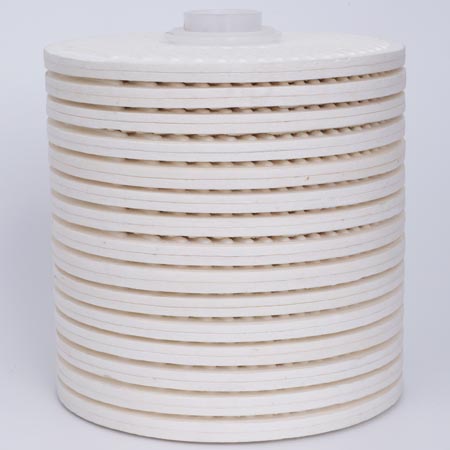
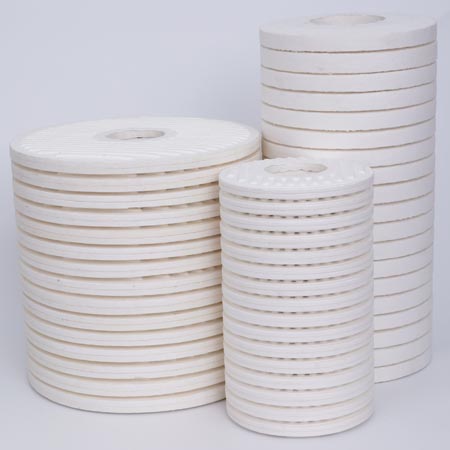
Depth filtration technology removes contaminants throughout a multi-layer, porous filter media, preventing rapid surface clogging and delivering high dirt-holding capacity, long service life, and stable flow performance. It is ideal for hydraulic oil and lubrication oil systems operating under high contamination conditions.
| Comparison dimension | Deep filtration (CJC / RRR / Pall disc filter) | Surface filtration (Standard cartridge / Woven mesh / Simple paper) | Why it matters |
|---|---|---|---|
| Filtration mechanism | Depth filtration – contaminants captured throughout the media thickness | Surface filtration – contaminants trapped primarily on the outer surface | Depth provides higher dirt holding before clogging |
| Dirt holding capacity | High — captures particles throughout entire media | Low to Moderate — surface only | Longer service life & fewer element changes |
| Particle capture efficiency | High — excellent for fine particles (≤1–3 µm) and sludge | Lower — limited to particles larger than surface pores | Better oil cleanliness and protection |
| Pressure drop profile | Gradual, stable with loading | Rapid increase as surface blocks | Longer usable life; fewer bypass events |
| Contaminant types removed | Fine particles, oxidation by-products, sludge, resins | Mainly large particulates | Critical for oil condition management & system longevity |
| Life cycle / service interval | Longer | Shorter | Lower maintenance frequency |
| Fluid compatibility | Wide — oils, high-viscosity fluids, complex chemistries | Generally fewer fluid types | More versatile for varying industrial oils |
| Typical media structure | Multi-layer deep packed, tortuous path | Single layer surface screen or simple bonded paper | Depth structure enables progressive capture |
| Suitability for offline filtration | Excellent — designed for continuous offline cleaning systems | Not suitable | Offline systems demand strong depth media |
| Application examples | Offline oil filtration (CJC/Triple R), fine fuel & lubricant purification | Basic hydraulic returns, reservoir strainer | Depth filters suit high-risk contamination environments |
| Cost efficiency (lifecycle) | Higher upfront but lower replacement cost per life | Lower upfront but faster replacement | Better TCO for demanding systems |
| Clogging behavior | Slower clogging due to internal capacity | Fast surface blockages | Depth keeps longer open pathways |
Deep filtration technologies provide significantly higher dirt-holding capacity, better fine particle capture, more stable pressure profile, and longer service life compared to surface filters.
These advantages make deep filters the preferred choice in offline oil filtration, fine particulate removal, and systems requiring extended maintenance intervals and
Key advantages of SINFT depth filtration solutions
SINFT adopts a multi-layer, density-gradient depth filtration structure that captures and disperses contaminants progressively within the filter media rather than relying on simple surface filtration. This design effectively prevents premature clogging and ensures reliable performance in high-contamination, high-load, long-term operating conditions.
Based on cellulose depth filtration media and optimized structural design, SINFT filter elements provide greater dirt-holding capacity within a compact volume. Compared with traditional surface filtration solutions, they significantly extend service life, reduce downtime and maintenance labor, and lower overall operating costs.
SINFT depth filtration filter elements utilize mature natural cellulose and composite media systems and are supported by long-term partnerships with premium filter media suppliers. This includes internationally recognized media systems such as HV (USA) and Donaldson/Lydall-based media from Korea, ensuring the material reliability required for demanding depth filtration applications.
SINFT depth filtration filter elements feature multi-layer density-gradient structures to distribute contaminants progressively within the media and delay clogging. Before mass production, each filter design is rigorously validated through:
SINFT CJC replacement filters are made from 100% sustainable natural cellulose with a multi-layer depth filtration structure, efficiently removing particles, moisture, and contaminants. Environmentally friendly and cost-saving, rigorously tested for reliability and durability, they extend oil life and optimize overall operating costs.

SINFT offers Triple R replacement filter elements made from deep composite and adsorptive depth filtration media, providing 100% full-size interchangeability with enhanced flexibility, stable supply, and cost efficiency.
Constructed from high-density cellulose blended with synthetic fibers, these filters employ true depth filtration, capturing contaminants throughout the entire media thickness rather than just on the surface, ensuring efficient and long-lasting filtration performance.

The SINFT replacement PALL disc filter module represents a key milestone in deep filtration technology, designed to deliver efficient, stable, and scalable clarification filtration solutions for biopharmaceuticals, vaccines, fermentation processes, and high-purity chemical applications.
Each SINFT disc filter module consists of three core components:

Standard models are kept in sufficient stock with stable lead times, enabling rapid response to both project-based requirements and routine maintenance needs. Supported by long-term supply capability, SINFT depth filtration solutions are not only ideal for one-time replacements but also well suited for continuous operation and system-level applications.


SINFT depth filtration elements can be customized based on system design, fluid characteristics, and operating conditions. Flexible options are available for element dimensions, media combinations, flow ratings, as well as element structure and connection interfaces.

SINFT maintains a sophisticated inventory management system with dedicated personnel and advanced software, ensuring a large stock of inventory items to serve ODM/OEM customers efficiently.

We strive to ensure timely delivery with rigorous quality checks before shipment, guaranteeing product reliability and customer satisfaction.


SINFT ensures efficient and accurate logistics through a centralized warehousing system. Every order undergoes scanning, packaging, and labeling at our unified distribution center, guaranteeing fast and precise delivery.

Our global partners rely on SINFT for consistent quality and dependable service.
SINFT is located in Shijiazhuang City, Hebei Province, covering 26,658㎡. Established in 2007, we have become an excellent manufacturer of brand-compatible spare parts in the industrial filtration and Oil Filtration Machine delivery industries with 18 years of experience accumulation and precipitation.

SINFT produces high quality filter machines and spare parts compatible with major brands in the world market with much more competitive prices. We measure our success by what our products do for you. Quality at SINFTFILTER means more than making a product in the right way. Every employee thinks about what he or she does and what is expected by our customers. Replacement Filter Elements for over 200 brands.

10 bard (150 psid) minimum for Coreless filter elements, 20 bard (300 psid) minimum for Standard filter elements, 210 bard.
Compatible with petroleum oils, water glycols, wateroil emulsions, and high water containing fluids. Fluorocarbon seals are
The operating flow rate and differential pressure of the filter element.
Fabrication integrity is validated and assured during the manufacturing process by numerous evaluations and.
Fluorocarbon seals: -29˚C (-20˚F) to +120˚C (+250˚F) Note: Maximum 60˚C (140˚F) in water based fluids. Other seal materials.
Contact factory; filter element pleats are fully supported, both upstream and downstream to achieve excellent fatigue cycle life..